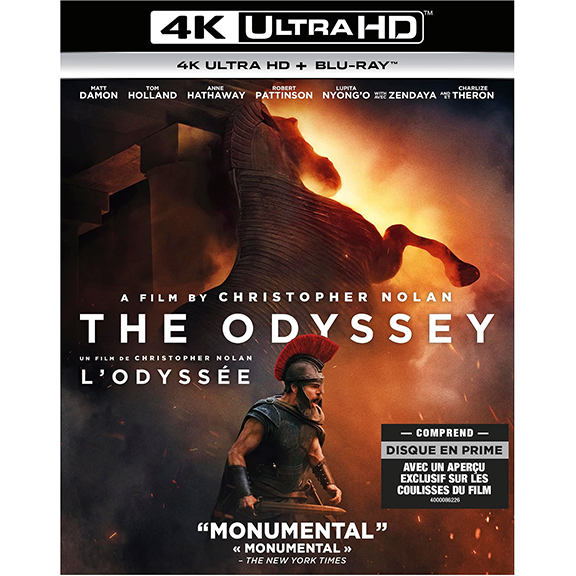
Directed by Christopher Nolan
By Sara
Taking on Homer’s legendary epic is no small undertaking, even for a filmmaker of Christopher Nolan’s stature. Following the extraordinary success of Oppenheimer, expectations were inevitably enormous. With The Odyssey, Nolan delivers an ambitious production that goes well beyond traditional adventure filmmaking. Beneath its spectacular imagery lies a darker examination of war, arrogance, accountability and the consequences of human ambition. Keep your eyes widely open on this epic journey.

Odysseus (Matt Damon), King of Ithaca, is an impressive warrior whose resourceful Trojan Horse ultimately contributes to the destruction of Troy. However, victory comes at a terrible moral cost. Rather than celebrating his achievement, the film presents the aftermath as an act of brutality that sets the stage for a long and punishing journey home. Hunted by monstrous creatures and seemingly abandoned by the gods, Odysseus and his surviving men become victims of the very arrogance that once made them conquerors.

Meanwhile, back in Ithaca, Penelope (Anne Hathaway) struggles to protect her kingdom from an increasingly aggressive collection of suitors eager to claim her hand and the throne. Their son, Telemachus (Tom Holland), embarks on his own journey to discover the truth about his missing father. Both storylines provide an emotional counterbalance to the violence and uncertainty surrounding Odysseus. Damon brings considerable depth to a character who is neither entirely valiant nor particularly innocent. Hathaway provides a dignified performance, while Holland effectively captures the uncertainty of a young man searching for his identity and family history.

What makes Nolan’s interpretation particularly interesting is its emphasis on the consequences of one generation’s failures. The film suggests that legends rarely tell the complete story and that those celebrated as heroes may leave behind a legacy of suffering. Its underlying message about forgiveness, family and breaking destructive cycles gives this ancient tale surprising relevance.
Visually, the 4K presentation is impressive, with excellent detail, natural textures and expansive cinematography. The preserves Nolan’s intended film-like appearance, although some darker sequences lack the depth expected from the 4k Ultra format. The 1.78:1 presentation also falls short of reproducing the original 1.43:1 IMAX theatrical framing. The English DTS-HD Master Audio 5.1 soundtrack is powerful and immersive, delivering thunderous bass, convincing environmental effects and an impressive presentation of Ludwig Göransson’s score. Dialogue occasionally competes with the aggressive sound design, while the absence of Dolby Atmos is upsetting. Ultimately, The Odyssey is an imposing cinematic achievement, occasionally excessive in its ambitions but undeniably memorable. Its greatest monsters may not be mythical creatures at all, but the destructive qualities of humanity itself. Don’t miss this epic motion picture, one of Christopher Nolan’s best films.
SPECIAL FEATURES
The 4K Ultra HD release includes more than 90 minutes of supplemental material, with the following extras:
Behind the Scenes – 12 Featurettes:
Plotting a Course
Icons
The Widest Window
On Location
The Horse
The Fall of Troy
Ithaca
Battle Ready
Apparent Magic
The Sea People
The Score
Bringing It Home
Additional Special Features:
IMAX Exclusive Prologue
The Journey of Film on The Odyssey
“When I’m Home” music video featuring James Blake, Travis Scott and Ludwig Göransson
Teaser Trailer
Trailer 1
Trailer 2
Countdown Trailer